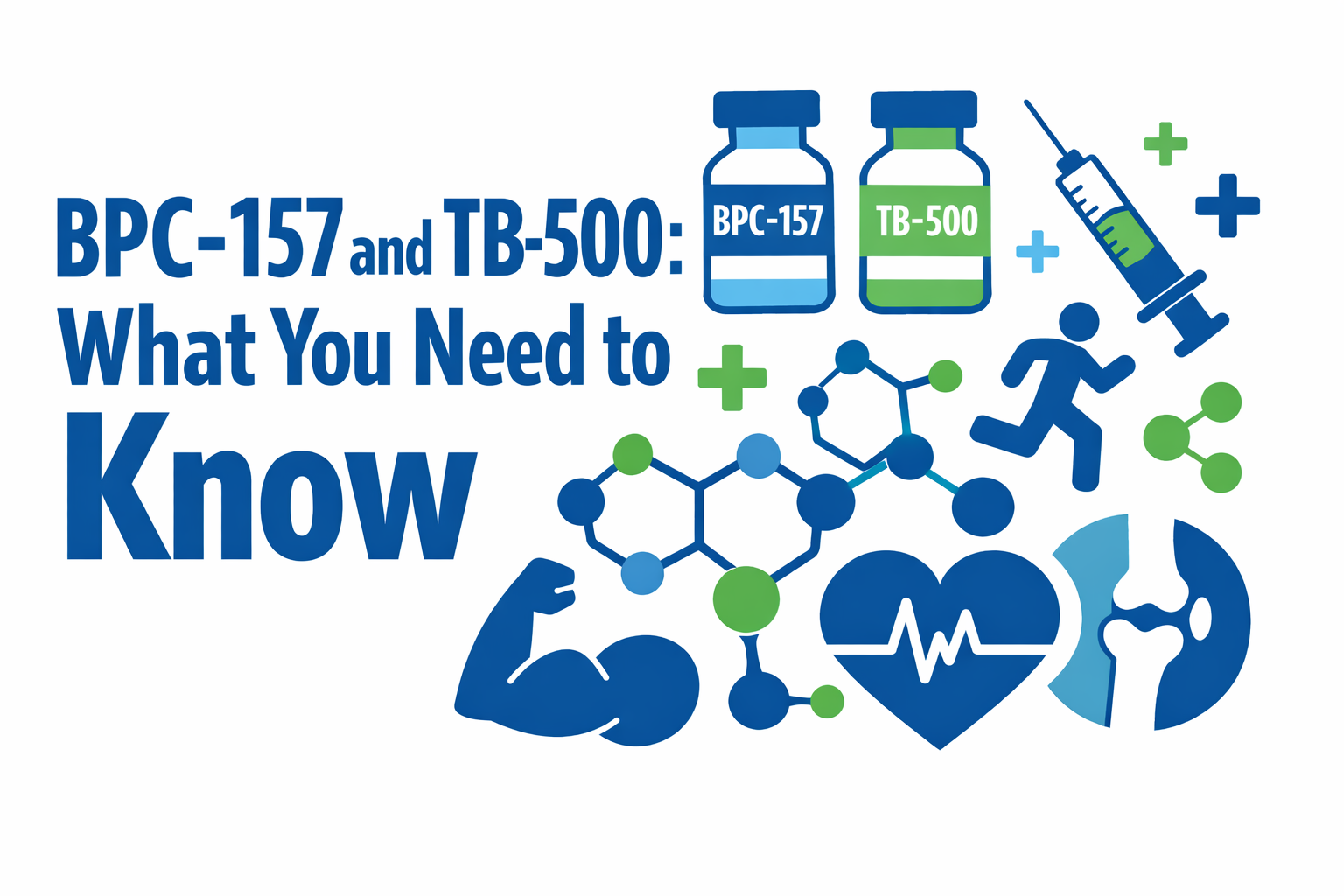
BPC-157 and TB-500: What You Need to Know
Two peptides have quietly become some of the most talked-about compounds in the recovery and performance space: BPC-157 and TB-500. Researchers, athletes, and biohackers have taken a serious interest in both, drawn by their reported ability to accelerate tissue repair, reduce inflammation, and support healing across multiple body systems. The science behind them is still evolving, but the preclinical data is compelling enough to warrant a thorough look.
Both compounds work through distinct but complementary mechanisms, which is part of what makes them so interesting when studied together. BPC-157 targets localized healing at the site of injury, while TB-500 promotes systemic recovery through cell migration and actin regulation. Understanding how each one works individually is the first step before exploring how they might be used together.
If you’re researching peptides for recovery, injury support, or general tissue health, this guide breaks down everything you need to know, from origins and mechanisms to dosing strategies, safety considerations, and the current regulatory landscape.
Understanding BPC-157 and TB-500
BPC-157: Origins and Core Mechanisms
BPC-157 stands for body protection compound-157, a synthetic peptide derived from a protein found in human gastric juice. It consists of 15 amino acids and was originally isolated from gastric peptide sequences during research into gastrointestinal protection and healing.
Its core mechanism involves the upregulation of growth hormone receptors and the activation of several healing pathways, including angiogenesis, the formation of new blood vessels. This vascular growth is central to how BPC-157 accelerates recovery in soft tissue, tendon, and ligament injuries.
BPC-157 also demonstrates strong anti-inflammatory properties, making it relevant not just for acute injuries but for chronic inflammation conditions as well. Researchers studying this compound have noted its ability to modulate nitric oxide production, which contributes to both its healing and protective effects.
TB-500: Origins and Core Mechanisms
TB-500 is a synthetic version of thymosin beta-4, a naturally occurring peptide found in virtually all human and animal cells. Thymosin beta-4 is known for its role in actin regulation, specifically in promoting cell migration and differentiation, both of which are essential for wound healing and tissue regeneration.
The half-life of TB-500 is notably longer than many other peptides, which contributes to its systemic reach throughout the body. Unlike BPC-157, which tends to work more locally, TB-500 travels through the bloodstream and supports healing across multiple tissue types simultaneously.
Its ability to promote collagen deposition and reduce inflammation makes TB-500 particularly valuable for muscle, tendon, and ligament recovery. For a deeper look at how this peptide functions on its own, the TB-500 peptide breakdown covers its mechanisms and applications in detail.
| Feature | BPC-157 | TB-500 |
|---|---|---|
| Origin | Gastric peptide (human stomach) | Thymosin beta-4 (natural protein) |
| Primary Mechanism | Angiogenesis, growth hormone receptor upregulation | Actin regulation, cell migration |
| Healing Scope | Localized tissue repair | Systemic recovery |
| Anti-Inflammatory | Yes | Yes |
| Collagen Support | Moderate | Strong |
| Half-Life | Short to moderate | Longer, systemic distribution |
Key Benefits and Mechanisms of Action
Individual Healing Applications
BPC-157 has shown remarkable results in preclinical models involving tendon and ligament injuries. Studies in animal models have demonstrated accelerated healing of Achilles tendon tears, rotator cuff damage, and various soft tissue wounds, largely attributed to its angiogenic and collagen-stimulating effects.
Beyond musculoskeletal applications, BPC-157 has also been studied for gut healing, neuroprotection, and even bone repair. Its origins as a gastric peptide mean it has a natural affinity for gastrointestinal tissue, and research has explored its potential in conditions like inflammatory bowel disease and leaky gut.
TB-500 shines in its ability to support recovery across a broader range of tissues simultaneously. Its role in actin binding allows it to facilitate the movement of cells to sites of injury, which is a foundational step in the wound healing process.

- Promotes muscle fiber regeneration after strain or tear
- Supports tendon and ligament repair through collagen synthesis
- Reduces systemic inflammation following acute injury
- Enhances flexibility and range of motion during recovery
- Supports cardiovascular tissue healing in preclinical models
Comparative Strengths and Differences
The key distinction between these two research peptides lies in their scope of action. BPC-157 is highly effective for targeted, localized healing, making it the preferred choice when dealing with a specific injury site. TB-500 operates more broadly, making it better suited for systemic recovery or when multiple areas need support.
Both peptides share anti-inflammatory properties, but they achieve this through different pathways. BPC-157 modulates nitric oxide and growth factor signaling, while TB-500 works through actin sequestration and cytokine regulation.
For those interested in how these compounds compare to other recovery-focused compounds, exploring the 5 best peptides for muscle building provides useful context on where BPC-157 and TB-500 fit within the broader peptide landscape.
Synergistic Use and Practical Protocols
The Wolverine Stack and Combination Benefits
The term “Wolverine Stack” refers to the combination of BPC-157 and TB-500, named after the fictional character known for rapid regeneration. This pairing has gained significant traction among researchers and performance-focused individuals because the two peptides appear to complement each other’s mechanisms in meaningful ways.
BPC-157 handles the localized repair work, stimulating angiogenesis and collagen production at the injury site. TB-500 simultaneously supports systemic healing, ensuring that cell migration and tissue remodeling occur throughout the body. Together, they address both the local and systemic dimensions of recovery.
The synergy between these compounds is one of the most discussed topics in peptide research communities. For a comprehensive breakdown of how this combination is structured and what to consider before using it, the Wolverine Stack guide covers protocols, expectations, and sourcing considerations in full detail.
- Addresses both localized and systemic injury simultaneously
- Reduces overall recovery time compared to single-peptide use
- Supports multiple tissue types including muscle, tendon, and ligament
- May enhance the anti-inflammatory effects of each individual peptide
Dosing, Administration, and Recovery Strategies
Dosage protocols for BPC-157 in research settings typically range from 200 to 500 micrograms per day, administered via subcutaneous injection near the injury site. Some protocols use intramuscular injection depending on the tissue being targeted.
TB-500 is generally used at higher doses during a loading phase, often between 2 to 2.5 milligrams twice per week, followed by a maintenance phase of lower, less frequent dosing. The longer half-life of TB-500 means it does not need to be administered as frequently as BPC-157.
Subcutaneous injection remains the most common administration route for both peptides in research contexts. Oral and intranasal forms of BPC-157 have also been explored, with some evidence suggesting oral administration retains bioactivity due to its gastric origins.
- BPC-157: 200 to 500 mcg daily via subcutaneous or intramuscular injection
- TB-500: 2 to 2.5 mg twice weekly during loading, reduced for maintenance
- Cycle length typically ranges from four to eight weeks
- Injection site should be near the area of injury for BPC-157
- TB-500 can be injected at any subcutaneous site due to systemic distribution
Research Evidence, Perspectives, and Risks
Preclinical Support and Expert Views
The majority of research on both peptides comes from animal studies, which have consistently shown positive outcomes for tissue repair, wound healing, and inflammation reduction. BPC-157 has an extensive body of preclinical literature supporting its effects on tendon, ligament, muscle, bone, and gastrointestinal tissue.
TB-500 research, particularly around thymosin beta-4, has also produced strong preclinical results, with studies showing improved cardiac tissue healing, enhanced wound healing rates, and reduced scarring. Some early-phase human trials involving thymosin beta-4 have been conducted, though large-scale clinical data remains limited.
Expert perspectives within the peptide research community tend to be cautiously optimistic. Researchers acknowledge the limitations of extrapolating animal data to humans while recognizing that the mechanistic evidence is scientifically sound. For a thorough review of what the existing science actually demonstrates, the BPC-157 research guide provides an evidence-based overview without overstating the current findings.

Safety Concerns and Regulatory Status
Neither BPC-157 nor TB-500 has received approval from major regulatory bodies for human therapeutic use. Both are classified as research peptides, meaning they are legally available for laboratory and research purposes but are not approved medications.
The safety profile of both compounds in animal studies has been generally favorable, with few reported adverse effects at standard research doses. However, the absence of large-scale human clinical trials means that long-term safety data in humans is not yet available.
- No major regulatory approval for human use in most jurisdictions
- Animal studies show a generally favorable short-term safety profile
- Potential side effects include injection site reactions and mild nausea
- Long-term human safety data is currently lacking
- Quality and purity of sourced peptides vary significantly between suppliers
Sourcing quality matters enormously with research peptides. Impure or mislabeled compounds can introduce risks that have nothing to do with the peptide itself. Anyone sourcing BPC-157 for research purposes should prioritize suppliers who provide third-party tested, verified products with transparent certificates of analysis.
Conclusion
BPC-157 and TB-500 represent two of the most scientifically interesting peptides in the current research space. Their complementary mechanisms, strong preclinical support, and growing community interest make them worth understanding in depth, whether you’re a researcher, a clinician, or simply someone exploring the science of recovery.
The evidence base is promising but still developing. Responsible use means staying informed, sourcing carefully, and approaching these compounds with realistic expectations grounded in what the current research actually shows rather than anecdotal hype.
FAQ
What is the Wolverine Stack?
The Wolverine Stack is the informal name for the combination of BPC-157 and TB-500 used together in a single recovery protocol. The name reflects the regenerative synergy between the two peptides, with BPC-157 targeting localized tissue repair and TB-500 supporting systemic healing across multiple tissue types simultaneously.
Are BPC-157 and TB-500 legal to use?
Both are classified as research peptides and are not approved for human therapeutic use by major regulatory agencies. They are generally legal to purchase for research purposes in many countries, but their legal status varies by jurisdiction. They are also banned by most sports organizations under anti-doping regulations.
What are common side effects?
Reported side effects in research contexts are generally mild and include injection site redness or irritation, mild nausea, and temporary dizziness. These effects are typically short-lived. Because large-scale human trials have not been conducted, a complete side effect profile for long-term human use has not been established.