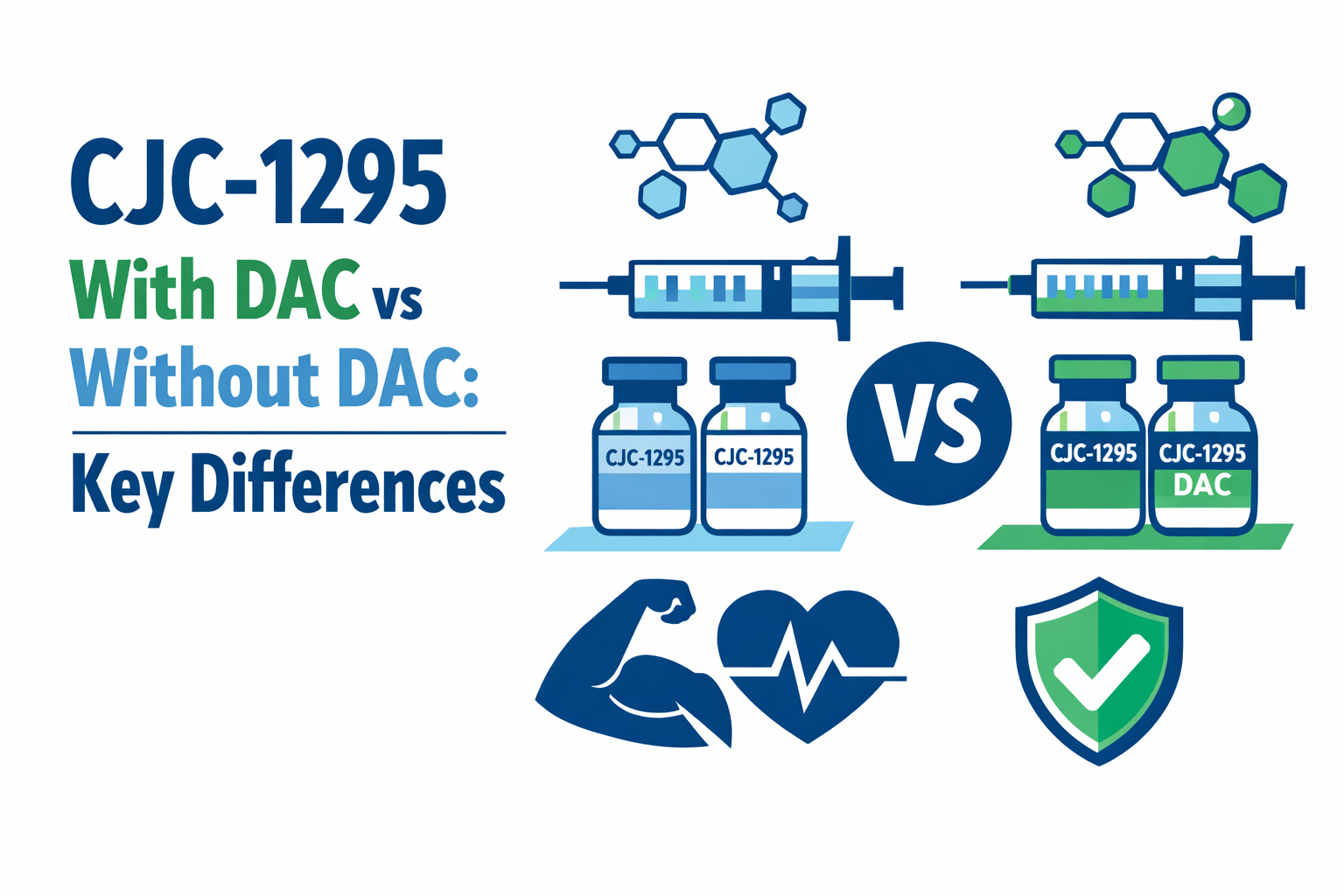
CJC-1295 With DAC vs Without DAC: Key Differences
CJC-1295 is one of the most researched growth hormone-releasing peptides available today, and the debate between using it with or without DAC is one that comes up constantly in peptide communities. Both versions work on the same fundamental mechanism, stimulating the pituitary gland to release growth hormone, but they behave very differently once inside the body. Understanding those differences is not just academic; it directly affects how you dose, what results you get, and whether the peptide fits your specific goals.
The term DAC stands for Drug Affinity Complex, a chemical modification that dramatically extends the plasma half-life of CJC-1295 by enabling albumin binding. Without this modification, the peptide is often referred to as Mod GRF 1-29, and it behaves much more like the body’s natural GHRH pulses. These two versions are not interchangeable, and treating them as such is a common mistake that leads to suboptimal results or unexpected side effects.
If you are exploring peptide stacks for muscle growth, fat loss, or anti-aging purposes, knowing which version suits your physiology and lifestyle is essential. This breakdown covers everything from half-life and dosing frequency to pricing, use cases, and the structural differences that make each version unique. For anyone also looking at combination stacks, the top peptides for muscle building guide offers useful context on how CJC-1295 fits alongside other compounds.
Feature-by-Feature Comparison
Before getting into the nuances, a side-by-side look at the core features helps frame the entire discussion. Both peptides are synthetic analogs of GHRH, but their pharmacokinetic profiles are strikingly different.
| Feature | CJC-1295 With DAC | CJC-1295 Without DAC (Mod GRF 1-29) |
|---|---|---|
| Half-Life | 6 to 8 days | 20 to 30 minutes |
| Dosing Frequency | Once or twice weekly | Multiple times daily |
| GH Release Pattern | Sustained, blunted pulse | Sharp, physiologic pulse |
| Albumin Binding | Yes | No |
| Common Combinations | Standalone or with GHRP | Ipamorelin, GHRP-2, GHRP-6 |
| IGF-1 Elevation | Prolonged increase | Transient increase |
| Somatostatin Interference | Higher risk | Lower risk |
Half-Life and Dosing Frequency
The most significant practical difference between these two peptides is the half-life. CJC-1295 with DAC has a plasma half-life of approximately six to eight days, which means a single subcutaneous injection can maintain elevated growth hormone levels throughout the week. This is made possible through albumin binding, where the DAC modification allows the peptide to attach to serum albumin and avoid rapid enzymatic degradation.
Mod GRF 1-29, the version without DAC, has a half-life of roughly twenty to thirty minutes. This short window requires multiple daily injections to maintain consistent stimulation of the pituitary gland. Most protocols call for two to three subcutaneous injections per day, typically timed around sleep and training.
The dosing frequency difference has real lifestyle implications. Weekly injections are far more convenient, but frequent dosing with Mod GRF 1-29 allows for more precise control over when growth hormone pulses occur. For those who prefer a structured, timed approach to peptide use, the shorter-acting version offers more flexibility in that regard.
Growth Hormone Release Patterns
The body naturally releases growth hormone in pulses, primarily during deep sleep and in response to exercise. Mod GRF 1-29 closely mimics this pulse release pattern, producing a sharp spike in growth hormone that mirrors what the pituitary gland does naturally. This is why many researchers and practitioners consider it the more physiologic option.
CJC-1295 with DAC creates what is often described as a “GH bleed,” a sustained, lower-amplitude elevation in growth hormone rather than a sharp pulse. This continuous stimulation can interfere with the body’s natural feedback mechanisms, including somatostatin, which is the hormone responsible for inhibiting growth hormone release. Prolonged receptor binding without natural off-periods may reduce receptor sensitivity over time.
IGF-1 levels respond differently to each version as well. With DAC, IGF-1 stays elevated for a longer period, which can be beneficial for sustained anabolic signaling. Without DAC, IGF-1 rises transiently following each injection, which some users find more manageable from a side effect standpoint.
Structural and Pharmacokinetic Differences
At the molecular level, both peptides share the same core amino acid sequence derived from the first twenty-nine amino acids of endogenous GHRH. The difference lies in the addition of the Drug Affinity Complex to the C-terminus of CJC-1295. This modification enables covalent binding to albumin in the bloodstream, dramatically extending its circulation time.
Mod GRF 1-29 lacks this modification and is cleared from plasma rapidly through enzymatic degradation. Its receptor binding is brief but highly specific, triggering a clean GHRH receptor response at the pituitary gland without prolonged occupation. This makes it a research peptide that behaves more predictably in terms of pulse dynamics.

The pharmacokinetic profile of each version also affects how they interact with other compounds in a stack. Because Mod GRF 1-29 has a narrow activity window, timing it precisely with a GHRP like ipamorelin produces a synergistic pulse that amplifies growth hormone output significantly. CJC-1295 with DAC does not require this precise timing, but the synergy with GHRPs is less pronounced due to the blunted pulse pattern.
Pricing Differences
Pricing between the two versions varies, and it is worth understanding why before making a purchasing decision. CJC-1295 with DAC typically costs more per vial due to the additional synthesis steps required to attach the DAC modification. The chemical process is more complex, and that complexity is reflected in the price.
Mod GRF 1-29 is generally less expensive per vial, but the total cost of a protocol can add up quickly given the higher dosing frequency. If you are injecting two to three times daily, you will go through vials faster than someone using the DAC version once or twice weekly.
- CJC-1295 with DAC: Higher upfront cost per vial, lower total consumption over time
- Mod GRF 1-29: Lower cost per vial, higher total consumption due to frequent dosing
- Combination protocols using Mod GRF 1-29 with ipamorelin may require purchasing two peptides simultaneously
- Bulk purchasing of Mod GRF 1-29 can offset the per-dose cost difference
When evaluating cost, factor in the full protocol duration rather than just the per-vial price. Over a twelve-week cycle, the total expenditure for both versions often ends up comparable, though individual supplier pricing varies considerably. Always verify peptide quality through a certificate of analysis; learning how to interpret a peptide COA is a critical skill before spending money on any research compound.
Unique Selling Points
Each version has distinct advantages that make it the better choice depending on what you are trying to accomplish. CJC-1295 with DAC wins on convenience. One or two injections per week is a dramatically simpler protocol, and for individuals who struggle with adherence to frequent dosing schedules, this matters enormously.
The sustained IGF-1 elevation from the DAC version also appeals to those focused on long-term anabolic support, particularly in bodybuilding contexts where consistent muscle growth signaling is valued. The prolonged growth hormone elevation supports fat loss over time as well, making it a popular choice for body recomposition goals.
- CJC-1295 with DAC offers unmatched convenience with weekly dosing
- Sustained IGF-1 elevation supports prolonged anabolic and fat loss signaling
- Mod GRF 1-29 produces physiologic pulse release that mirrors natural GHRH activity
- Without DAC, somatostatin interference is minimized, preserving receptor sensitivity
- Mod GRF 1-29 pairs exceptionally well with ipamorelin and other GHRPs for amplified pulses
- The shorter half-life of Mod GRF 1-29 allows for more precise control over timing
Mod GRF 1-29 is the preferred option for those who prioritize physiologic accuracy and want to work with the body’s natural rhythms rather than override them. Anti-aging protocols in particular tend to favor this approach, as preserving the natural pulsatile pattern of growth hormone release is considered important for long-term hormonal health.
Specific Use Case Scenarios
Choosing between these two peptides becomes clearer when you map them to specific goals and lifestyles. For someone focused on bodybuilding and muscle growth who trains intensely and wants maximum anabolic support, CJC-1295 with DAC offers a straightforward, high-impact option. The sustained growth hormone and IGF-1 elevation supports recovery, protein synthesis, and lean mass accumulation without requiring precise daily timing.

For someone pursuing anti-aging benefits with a focus on sleep quality, skin health, and metabolic function, Mod GRF 1-29 combined with ipamorelin is often the preferred protocol. The pulse release pattern supports natural sleep-associated growth hormone secretion, which is central to many anti-aging mechanisms. This combination is also gentler on the feedback axis, reducing the risk of desensitization over extended use.
Fat loss protocols can work with either version, but the approach differs. With DAC, the sustained growth hormone elevation promotes lipolysis continuously throughout the week. Without DAC, fat loss is driven by repeated acute pulses that stimulate metabolic activity in a more intermittent pattern. Some users report better results with one over the other, and individual response varies.
For research purposes, Mod GRF 1-29 is often preferred because its short half-life allows for cleaner experimental designs where timing and dose-response relationships can be studied more precisely. The DAC version’s prolonged activity makes it harder to isolate specific variables in a research context.
Those exploring combination stacks that include recovery-focused peptides alongside growth hormone secretagogues may find it useful to review the breakdown of BPC-157 and TB-500, which covers how tissue repair peptides interact within broader protocols. Understanding how different peptides complement each other is key to building an effective stack.
Sermorelin is another GHRH analog that often comes up in comparisons with both versions of CJC-1295. Sermorelin has a shorter half-life than even Mod GRF 1-29 and is considered the most conservative option for stimulating the pituitary gland. For those new to growth hormone peptides, sermorelin is sometimes recommended as a starting point before transitioning to CJC-1295 variants.
Conclusion
Both versions of CJC-1295 are effective tools for stimulating growth hormone release, but they serve different purposes and suit different users. The DAC version prioritizes convenience and sustained hormonal elevation, making it well-suited for bodybuilding, fat loss, and users who prefer minimal injection frequency. Mod GRF 1-29 prioritizes physiologic accuracy, receptor sensitivity preservation, and precise timing, making it the better fit for anti-aging protocols and those who want to work closely with the body’s natural rhythms.
Neither version is universally superior. The right choice depends on your goals, your lifestyle, your tolerance for frequent injections, and how your body responds to sustained versus pulsatile growth hormone stimulation. Starting with a clear protocol, sourcing quality peptides, and monitoring your response over time will always produce better outcomes than simply choosing the most popular option.
For those building out a more comprehensive peptide protocol, the Wolverine Stack guide provides a detailed look at how multiple peptides can be combined strategically for recovery and performance goals.
FAQ
Which has a longer half-life: CJC-1295 with DAC or without DAC?
CJC-1295 with DAC has a significantly longer half-life of approximately six to eight days, compared to the twenty to thirty minute plasma half-life of Mod GRF 1-29. This difference is entirely due to the Drug Affinity Complex modification, which enables albumin binding and protects the peptide from enzymatic degradation. The extended half-life is the primary reason the DAC version requires only once or twice weekly subcutaneous injections.
Is CJC-1295 without DAC more physiologic than with DAC?
Yes, Mod GRF 1-29 is widely considered the more physiologic option because its pulse release pattern closely mirrors the natural GHRH activity of the body. The pituitary gland responds to brief, sharp signals from GHRH, and Mod GRF 1-29 replicates this dynamic accurately. CJC-1295 with DAC creates a prolonged, continuous stimulation that does not reflect natural growth hormone secretion patterns, which can affect somatostatin feedback and receptor sensitivity over time.
What are common combinations for CJC-1295 without DAC?
Mod GRF 1-29 is most commonly combined with ipamorelin, which is a selective GHRP that amplifies the growth hormone pulse without significantly raising cortisol or prolactin. This combination is considered one of the cleanest and most effective stacks for both muscle growth and anti-aging purposes. Other combinations include GHRP-2 and GHRP-6, which produce stronger growth hormone pulses but come with more pronounced side effects such as increased appetite. The timing of these combinations is critical, as both peptides should be administered simultaneously to maximize the synergistic pulse at the pituitary gland.