
MOD GRF 1-29: What You Need to Know
Mod GRF 1-29 has become one of the most talked-about peptides in research and performance circles. It belongs to a class of compounds known as growth hormone releasing hormone analogs, and its ability to stimulate natural growth hormone secretion has made it a subject of serious interest among researchers, clinicians, and bodybuilding enthusiasts alike.
Unlike synthetic growth hormone, this peptide works by signaling the anterior pituitary gland to produce and release growth hormone in a natural, pulsatile pattern. That distinction matters enormously, both for safety and for how the body responds over time. The result is a more physiologically appropriate hormone response compared to direct GH administration.
If you are exploring peptide-based approaches to muscle growth, fat loss, recovery, or anti-aging, understanding how Mod GRF 1-29 works is essential. This guide covers everything from its chemical structure and mechanism of action to dosage protocols, stacking strategies, and safety considerations.
Understanding Mod GRF 1-29
Mod GRF 1-29 is a modified version of the naturally occurring growth hormone releasing hormone. The original GHRH peptide degrades rapidly in the bloodstream, making it impractical for research or therapeutic use. Mod GRF 1-29 was engineered to solve that problem by extending its half-life while preserving its biological activity.
It is sometimes confused with CJC-1295, but these are distinct compounds. The key difference lies in whether a Drug Affinity Complex, or DAC, is attached. Mod GRF 1-29 does not contain DAC, which means it produces a shorter, more controlled pulse of growth hormone rather than a prolonged elevation.
Chemical Structure and Modifications
The original GHRH peptide contains 44 amino acids, but only the first 29 are required for receptor binding and activity. Mod GRF 1-29 is built from this 1-29 fragment with four specific amino acid substitutions, which is why it is sometimes called a tetrasubstituted analog.
These four modifications protect the peptide from enzymatic degradation, extending its half-life from just a few minutes to approximately 30 minutes. That window is long enough to produce a meaningful growth hormone pulse without causing the prolonged, supraphysiological elevations associated with DAC-containing versions.
| Feature | Natural GHRH | Mod GRF 1-29 | CJC-1295 with DAC |
|---|---|---|---|
| Amino Acids | 44 | 29 (modified) | 29 (modified + DAC) |
| Half-Life | Under 2 minutes | Approximately 30 minutes | Several days |
| GH Release Pattern | Pulsatile | Pulsatile | Sustained elevation |
| DAC Attached | No | No | Yes |
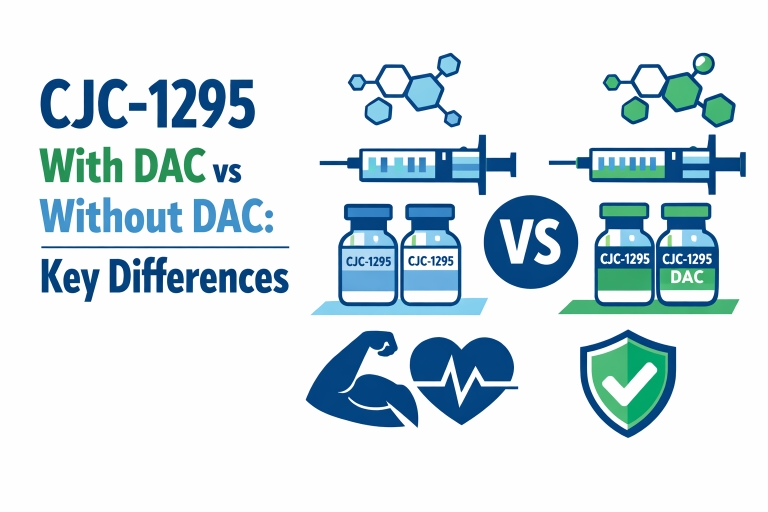
For a deeper look at how DAC changes the pharmacokinetics of these peptides, the comparison of CJC-1295 with and without DAC provides useful context for understanding which version suits specific research goals.
Mechanism of Action
Mod GRF 1-29 binds to GHRH receptors located on somatotroph cells in the anterior pituitary gland. This binding triggers a signaling cascade that results in the synthesis and release of growth hormone into the bloodstream.
The pulsatile release pattern it produces closely mirrors the body’s natural GH secretion rhythm. This is considered a significant advantage over continuous GH elevation, which can desensitize receptors and disrupt normal hormonal feedback loops.
Once growth hormone is released, it travels to the liver and other tissues where it stimulates the production of insulin-like growth factor 1, commonly known as IGF-1. IGF-1 is responsible for many of the downstream anabolic and metabolic effects attributed to growth hormone.
Benefits and Applications
The interest in Mod GRF 1-29 spans multiple fields, from sports performance and bodybuilding to anti-aging medicine and clinical research. Its ability to amplify natural GH pulses without replacing endogenous hormone production makes it a versatile research peptide with a broad range of potential applications.
Researchers and practitioners often highlight its favorable profile compared to exogenous growth hormone. Because it works through the body’s own regulatory systems, the risk of completely suppressing natural GH production is considered lower.
Muscle Growth and Recovery
Elevated growth hormone and IGF-1 levels support protein synthesis, which is the foundation of muscle growth. Users and researchers report that Mod GRF 1-29 contributes to improved nitrogen retention and faster recovery from training-related muscle damage.
The peptide’s effects on connective tissue are also notable. Growth hormone supports collagen synthesis, which means tendons, ligaments, and joints may benefit alongside skeletal muscle.
- Enhanced protein synthesis supporting lean muscle development
- Faster recovery between training sessions
- Improved connective tissue integrity and joint support
- Increased IGF-1 levels contributing to anabolic signaling
- Potential for improved sleep quality, which further supports recovery

Fat Loss and Metabolic Effects
Growth hormone has well-documented lipolytic properties, meaning it promotes the breakdown of stored fat for energy. Mod GRF 1-29, by amplifying GH pulses, can support fat loss particularly in stubborn areas like the abdomen.
Metabolic improvements extend beyond fat oxidation. Elevated GH levels can improve insulin sensitivity over time and support a more favorable body composition overall. This combination of muscle-sparing and fat-burning effects is a primary reason the peptide attracts interest in anti-aging and body recomposition contexts.
The anti-aging applications of peptides like Mod GRF 1-29 often overlap with other research compounds. For those exploring metabolic optimization, understanding how compounds like 5-Amino-1MQ work alongside peptide protocols can offer a more complete picture of available research tools.
Usage Guidelines and Stacking
Proper usage of Mod GRF 1-29 requires attention to reconstitution, timing, and administration technique. As a lyophilized research peptide, it must be reconstituted with bacteriostatic water before use. Accurate dosage measurement and correct storage are non-negotiable for maintaining peptide integrity.
The peptide is administered via subcutaneous injection, typically into the abdominal fat tissue. Injection timing relative to meals and sleep can significantly influence the magnitude of the GH pulse produced.
Dosage and Administration
The most commonly referenced dosage in research contexts is 100 micrograms per injection. This amount is typically administered two to three times daily, with timing aligned to natural GH release windows such as fasting states and pre-sleep periods.
Reconstitution involves adding bacteriostatic water to the lyophilized powder slowly and allowing it to dissolve without agitation. Shaking the vial can damage the peptide structure and reduce potency.
- Standard research dosage: 100 mcg per injection
- Frequency: Two to three times daily depending on protocol
- Administration route: Subcutaneous injection into abdominal tissue
- Reconstitution: Use bacteriostatic water, avoid shaking
- Storage: Refrigerate after reconstitution, use within a defined period
- Timing: Fasted state or pre-sleep for optimal GH pulse amplitude
Common Combinations with Other Peptides
Mod GRF 1-29 is rarely used in isolation. Its most popular pairing is with a growth hormone releasing peptide, or GHRP, such as ipamorelin or sermorelin. This combination produces a synergy that amplifies the GH pulse beyond what either compound achieves alone.
The mechanism behind this synergy involves two complementary pathways. Mod GRF 1-29 acts on GHRH receptors while GHRPs act on ghrelin receptors, and stimulating both simultaneously produces a significantly larger and more robust GH release.
- Mod GRF 1-29 plus ipamorelin: The most popular combination for clean GH release with minimal side effects
- Mod GRF 1-29 plus GHRP-2: A more aggressive stack with stronger GH output
- Mod GRF 1-29 plus GHRP-6: Produces strong GH release but may increase appetite significantly
- Mod GRF 1-29 plus sermorelin: Sometimes used in clinical anti-aging protocols
Ipamorelin is generally considered the preferred GHRP pairing because it produces selective GH release without significantly elevating cortisol or prolactin, making the combination cleaner and better tolerated.
Safety, Side Effects, and Perspectives

No peptide is without risk, and Mod GRF 1-29 is no exception. While its side effect profile is generally considered mild compared to exogenous growth hormone, users and researchers should be aware of what to expect and how to minimize adverse outcomes.
The peptide’s mechanism of working through natural regulatory systems is a point in its favor. However, amplifying GH pulses beyond normal physiological ranges still carries potential consequences that deserve careful consideration.
Reported Side Effects and Risks
The most commonly reported side effects are mild and transient. Water retention is frequently noted, particularly in the early stages of use, as growth hormone promotes sodium and water reabsorption.
- Water retention and mild bloating, especially early in a protocol
- Tingling or numbness in the extremities, related to fluid shifts
- Injection site redness or irritation from subcutaneous administration
- Temporary fatigue or lethargy following injections
- Potential for elevated blood glucose if GH levels rise significantly
- Headaches reported by some users, typically resolving with dose adjustment
Serious adverse effects are rare when the peptide is used within reasonable research parameters. The risk profile increases when dosages are excessive or when the compound is combined with multiple other hormonal agents without appropriate oversight.
Research vs. Practical Use Views
From a research standpoint, Mod GRF 1-29 is classified as a research peptide and is not approved for human therapeutic use in most jurisdictions. Academic and clinical researchers value it for studying GH axis physiology and exploring potential therapeutic applications.
Practical users in bodybuilding and anti-aging communities take a different view, often treating published research and anecdotal reports as sufficient justification for personal use. This gap between formal research status and real-world application is common across the peptide space.
Just as other research peptides like kisspeptin occupy a space between active research and practical application, Mod GRF 1-29 sits in a similar position where scientific interest and community use coexist without full regulatory clarity.
The responsible approach involves understanding that research peptides exist in a regulatory gray area. Anyone considering their use should consult with a qualified healthcare professional and approach the subject with appropriate caution and informed judgment.
Conclusion
Mod GRF 1-29 represents a sophisticated approach to growth hormone optimization. By working through the body’s own GHRH receptors to produce pulsatile GH release, it offers a more physiologically aligned alternative to direct growth hormone administration.
Its applications in muscle growth, fat loss, recovery, and anti-aging research are well-supported by both mechanistic understanding and practical observation. When combined with a complementary GHRP like ipamorelin, the synergistic effect on GH output makes it one of the more compelling peptide combinations available in research contexts.
Understanding the distinction between Mod GRF 1-29 and related compounds like CJC-1295 with DAC is essential for anyone evaluating these tools seriously. The presence or absence of DAC fundamentally changes the pharmacokinetic profile and the type of GH response produced.
Responsible use requires proper reconstitution with bacteriostatic water, correct storage, accurate dosage, and awareness of potential side effects. Approaching this peptide with informed caution and professional guidance is the most sensible path forward.
FAQ
What is Mod GRF 1-29?
Mod GRF 1-29 is a modified GHRH analog derived from the first 29 amino acids of natural growth hormone releasing hormone. It contains four amino acid substitutions that extend its half-life and protect it from enzymatic degradation, making it a more practical research peptide than native GHRH. It stimulates the anterior pituitary to release growth hormone in a pulsatile pattern that closely mirrors natural physiology.
What are the main benefits of Mod GRF 1-29?
The primary benefits associated with Mod GRF 1-29 include support for lean muscle growth through elevated IGF-1 and protein synthesis, enhanced fat metabolism through GH-driven lipolysis, improved recovery from physical stress, and potential anti-aging effects related to sustained GH optimization. Many users also report improved sleep quality, which itself contributes to recovery and hormonal balance. These benefits are most pronounced when the peptide is combined with a GHRP to maximize the synergy between the two complementary GH-stimulating pathways.
Is Mod GRF 1-29 safe for use?
Mod GRF 1-29 has a relatively mild side effect profile compared to exogenous growth hormone. Commonly reported effects include temporary water retention, tingling in the extremities, and minor injection site reactions. Serious adverse effects are uncommon at standard research dosages. However, it remains a research peptide without formal approval for human therapeutic use, and its safety profile in long-term human use has not been established through large-scale clinical trials. Consulting a qualified healthcare professional before use is strongly recommended.