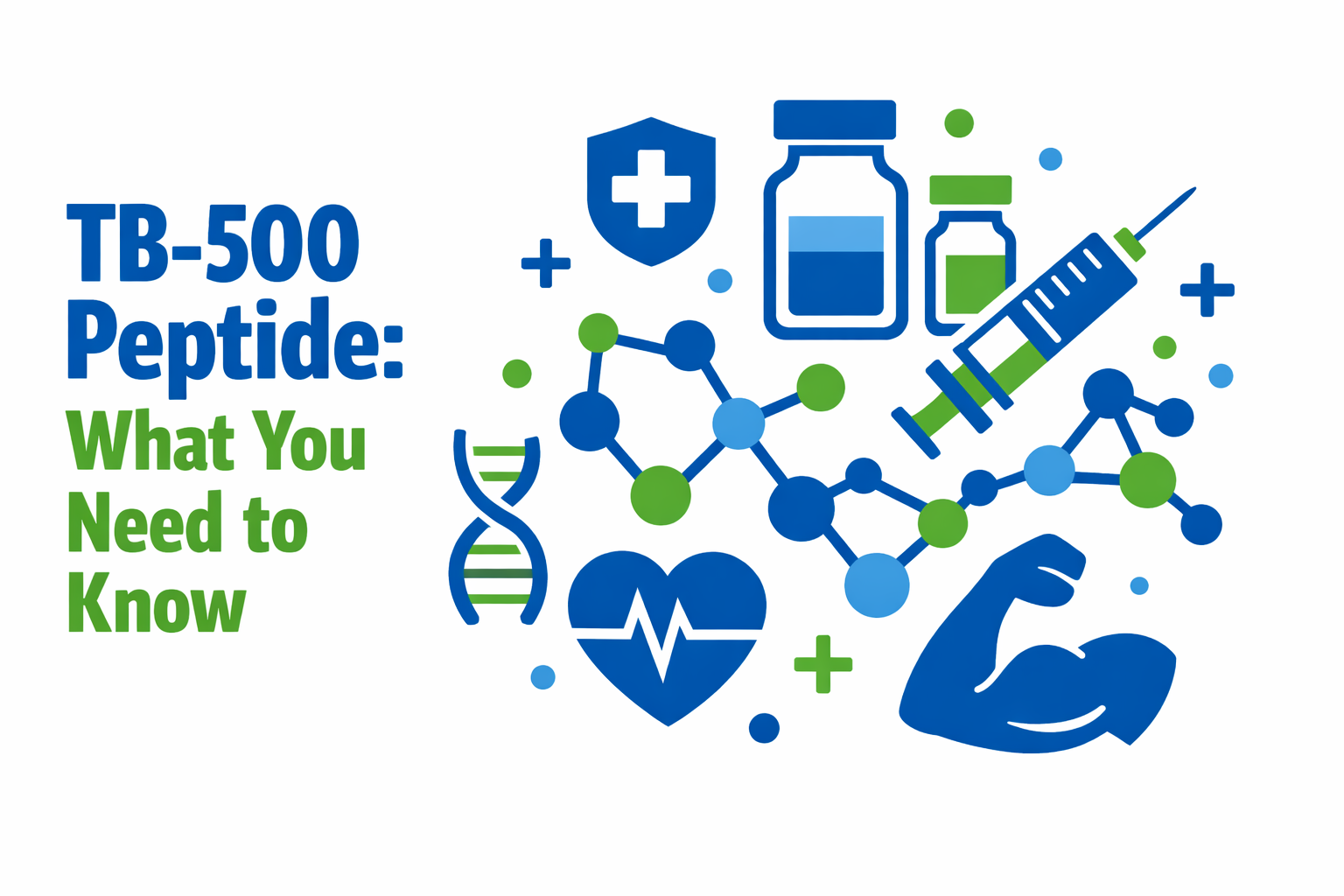
TB-500 Peptide: What You Need to Know
TB-500 peptide has been generating serious attention in research and athletic communities alike. It’s a synthetic version of a naturally occurring protein fragment, and its potential to support tissue repair, reduce inflammation, and accelerate recovery has made it one of the most discussed research peptides available today.
If you’ve been exploring peptide therapy or looking into options for injury recovery, you’ve likely come across TB-500. Understanding what it actually is, how it works, and what the current research says is essential before drawing any conclusions about its value or safety.
This guide breaks down everything you need to know about TB-500 peptide, from its molecular origins to its regulatory status, so you can approach the topic with clarity and confidence.
What is TB-500?
TB-500 is a synthetic peptide derived from a naturally occurring protein called thymosin beta-4. It was developed specifically for research purposes and is widely studied for its regenerative and anti-inflammatory properties.
Origins and Structure
TB-500 is a short peptide sequence taken from the active region of thymosin beta-4. Specifically, it corresponds to amino acids 17 through 23 of the full protein, making it a highly targeted fragment with concentrated biological activity.
The peptide sequence LKKTETQ is the core of TB-500’s structure. This small chain is responsible for most of the functional properties associated with the full thymosin beta-4 molecule, including its ability to bind actin and regulate cell movement.
Its compact structure gives it advantages in bioavailability and stability compared to larger peptide molecules. Researchers have found it easier to study in controlled settings because of its predictable behavior in biological systems.
| Feature | TB-500 | Thymosin Beta-4 |
|---|---|---|
| Type | Synthetic peptide fragment | Naturally occurring protein |
| Amino Acids | 7 (fragment) | 43 (full chain) |
| Primary Use | Research chemical | Biological research |
| Bioavailability | High (synthetic) | Variable |
| Half-life | Moderate | Shorter |
Comparison to Thymosin Beta-4
Thymosin beta-4 is a protein found naturally in virtually all human and animal cells. It plays a central role in actin regulation, wound healing, and cellular communication throughout the body.
TB-500 was designed to replicate the most therapeutically relevant portion of thymosin beta-4. By isolating the active peptide sequence, researchers aimed to create a more focused compound that could be studied with greater precision.
The key distinction is that TB-500 is a research chemical, not a pharmaceutical drug. It has not gone through the same clinical research pipeline as approved medications, which means its use in humans remains outside regulated medical practice.
Just as researchers explore compounds like those covered in this overview of the Cortagen peptide, TB-500 represents a class of bioactive fragments being studied for their targeted effects on specific biological pathways.
Mechanisms of Action
Understanding how TB-500 works at a cellular level helps explain why it has attracted so much interest in research settings. Its effects are not random. They follow specific biological pathways that are well-documented in preclinical studies.
Actin Regulation and Cell Migration
The primary mechanism of TB-500 involves its interaction with actin, a protein that forms the structural framework of cells. By binding to G-actin, TB-500 helps regulate how cells move, divide, and respond to injury.
This actin-binding activity is what makes TB-500 particularly relevant to tissue repair. When cells can migrate more efficiently to a wound site, healing accelerates significantly.
Cell migration is a foundational step in every repair process the body undertakes. TB-500’s ability to enhance this process is one of the main reasons it continues to be a subject of active clinical research.
The peptide also influences gene expression related to cell survival and differentiation. This broader effect on cellular behavior suggests TB-500 may have applications beyond simple wound healing.

Angiogenesis and Anti-Inflammatory Effects
TB-500 has demonstrated the ability to promote angiogenesis, which is the formation of new blood vessels. New blood vessel growth is critical for delivering oxygen and nutrients to damaged tissue during recovery.
In animal studies, TB-500 has shown consistent inflammation reduction at injury sites. This anti-inflammatory action works alongside its regenerative properties to create a more favorable healing environment.
The combination of angiogenesis promotion and anti-inflammatory activity makes TB-500 a uniquely multifunctional research peptide. Most compounds studied for recovery tend to focus on one mechanism, not both simultaneously.
Collagen synthesis also appears to be influenced by TB-500 activity. Collagen is the structural protein that gives repaired tissue its strength and integrity, making this an important secondary benefit observed in research models.
Potential Benefits and Uses
The potential applications of TB-500 span multiple areas of medicine and performance research. While human clinical data remains limited, preclinical findings have been consistently promising across several categories.
Tissue Repair and Recovery
TB-500’s most studied application is tissue repair. Research in animal models has shown accelerated healing of skin wounds, muscle tears, and connective tissue damage following administration of the peptide.
Wound healing studies have demonstrated that TB-500 can reduce recovery time and improve the quality of repaired tissue. This includes both the speed of closure and the structural integrity of the healed area.
Cardiac repair is another area where TB-500 has shown notable results in preclinical models. Studies involving heart tissue damage have found that TB-500 may support the regeneration of cardiac cells, which are notoriously difficult to repair naturally.
Hair growth has also been observed as a secondary effect in some research models. While not the primary focus of most studies, this finding has contributed to broader interest in TB-500’s regenerative potential across different tissue types.
Applications in Sports and Injuries
Athletes and fitness communities have taken significant interest in TB-500 for muscle recovery and injury recovery purposes. The peptide’s ability to reduce inflammation and accelerate tissue repair aligns directly with the demands of high-intensity training.
Tendon and ligament injuries, which are notoriously slow to heal, have been a particular focus. Animal studies suggest TB-500 may meaningfully shorten recovery timelines for these types of injuries.
For those researching peptide combinations, the BPC-157 research guide offers useful context on how similar peptides are being studied for overlapping recovery applications. Understanding both compounds helps clarify where each one fits in the broader research landscape.
Muscle recovery following intense exercise is another area of interest. By reducing localized inflammation and supporting cellular repair, TB-500 may help athletes return to training faster with less residual tissue damage.
Safety, Risks, and Regulatory Status
No discussion of TB-500 is complete without addressing its safety profile and legal standing. These are not minor considerations. They are central to any responsible evaluation of this compound.
Research Limitations and Side Effects
The most significant limitation of TB-500 research is the absence of large-scale human clinical trials. Most available data comes from animal studies, which, while informative, cannot be directly extrapolated to human outcomes.
Reported side effects in research settings have generally been mild. These include temporary fatigue, headache, and localized reactions at the injection site, particularly with subcutaneous injection or intramuscular injection administration.
- Injection site irritation or redness
- Temporary fatigue following administration
- Mild headache in some research subjects
- Nausea reported in isolated cases
- Potential interactions with other peptides or compounds
The half-life of TB-500 is considered moderate, meaning it remains active in the body long enough to exert its effects without accumulating to potentially problematic levels under standard research dosage protocols.
Dosage guidance for TB-500 is not standardized because it lacks regulatory approval for human use. Any dosage information circulating in online communities is based on anecdotal reports or extrapolations from animal research, not controlled human trials.
Long-term safety data simply does not exist for TB-500 in humans. This is a critical gap that cannot be overlooked when evaluating the compound’s risk profile.
Legal and Ethical Considerations
TB-500 occupies a complicated legal space. It is not approved by the FDA or equivalent regulatory bodies in most countries for human therapeutic use. It is sold legally as a research chemical for laboratory use only.

Many sports organizations, including the World Anti-Doping Agency, have banned TB-500 for use in competitive athletes. Its presence on prohibited substance lists reflects both its performance-relevant properties and the lack of regulatory oversight.
- Not approved for human use by the FDA
- Banned by major sports anti-doping organizations
- Legal to purchase in many regions as a research chemical
- Illegal to administer to humans in clinical or personal settings in most jurisdictions
- Quality and purity of commercially available products vary significantly
The ethical dimension matters too. Using a compound with limited human safety data introduces risks that are difficult to quantify, and the absence of medical supervision compounds those risks considerably.
Conclusion
TB-500 peptide represents one of the more scientifically grounded research chemicals currently being studied for tissue repair, muscle recovery, and anti-inflammatory applications. Its mechanisms are well-understood at a preclinical level, and the results from animal research are genuinely compelling.
The gap between preclinical promise and clinical reality remains wide. Without robust human trials, the full picture of TB-500’s safety, optimal dosage, and long-term effects cannot be drawn with confidence.
For anyone interested in the broader world of peptide therapy, exploring well-researched compounds and understanding their mechanisms is always the right starting point. Resources like the Vesugen peptide guide offer additional context on how different peptide classes are being investigated for specific biological targets.
TB-500 is not a finished product. It is a research tool with significant potential that deserves serious scientific attention rather than premature widespread use.
FAQ
Is TB-500 FDA-approved for human use?
No. TB-500 is not FDA-approved for human use. It is classified as a research chemical and is legally available only for laboratory research purposes. Administering it to humans outside of an approved clinical trial setting is not sanctioned by regulatory authorities.
What are common administration methods for TB-500?
In research settings, TB-500 is most commonly administered via subcutaneous injection or intramuscular injection. Subcutaneous injection involves delivering the peptide into the tissue just beneath the skin, while intramuscular injection targets deeper muscle tissue. Both methods are used in animal research protocols, and bioavailability appears reasonable with either approach.
Can TB-500 be combined with other peptides like BPC-157?
Combining TB-500 with BPC-157 is a topic frequently discussed in research communities. Both peptides have overlapping interests in tissue repair and injury recovery, and some researchers hypothesize that their mechanisms may be complementary. However, no controlled human studies have evaluated this combination, and any conclusions about synergistic effects remain speculative based on current evidence.